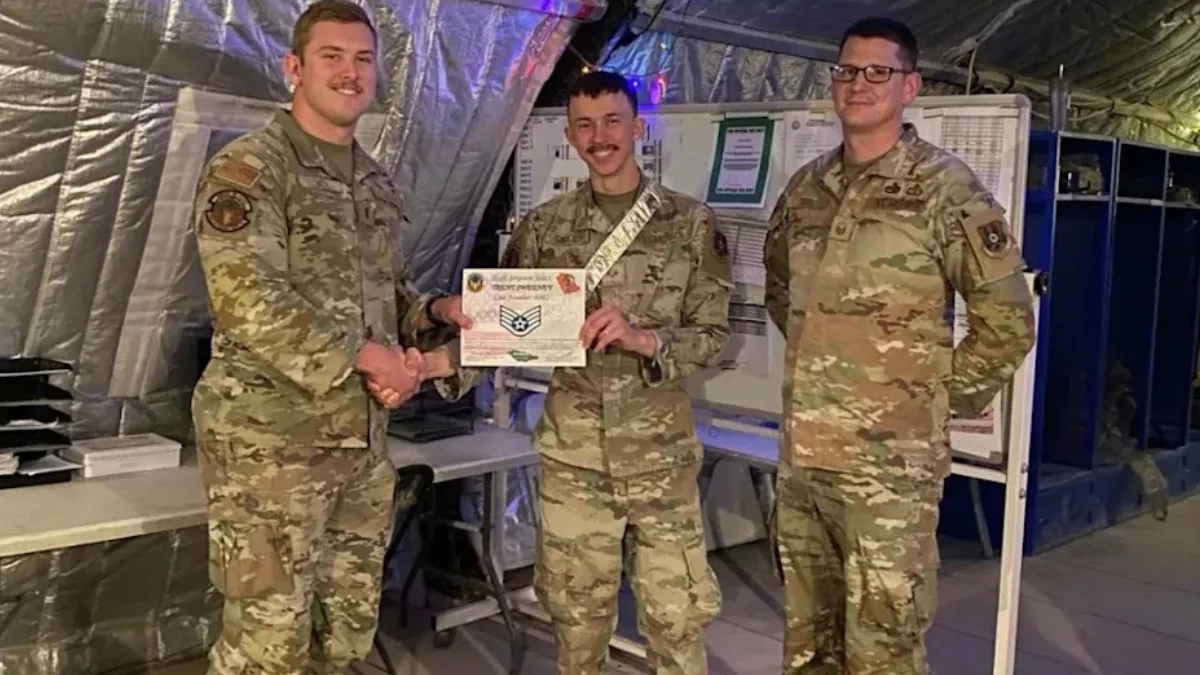
- Sydney Sweeney, 28, revealed on Tuesday, March 24, that her younger brother Trent, a US Air Force staff sergeant, has been deployed overseas, sharing a FaceTime screenshot of him in full military gear alongside a heartfelt message supporting all troops serving abroad.
- Trent has been serving in an Air Force munitions squadron since around 2020, was promoted to staff sergeant in August 2025, and has been deployed overseas multiple times, though details surrounding his current assignment have not been publicly disclosed.
- The US military is actively deploying thousands of Marines and additional battleships to the Middle East, even as Trump officials engage in talks aimed at ending the war with Iran, making the question of Trent’s destination impossible to ignore.
When Sydney Sweeney posted a casual FaceTime screenshot of her brother in a helmet and camouflage, it looked like a sweet sibling moment. But with a full-scale war unfolding in the Middle East and thousands of American troops heading to the region right now, one question immediately started circulating online: Is Trent Sweeney deployed because of the Iran war?
Here is everything we actually know.
What Sydney Said and What She Didn’t
Sydney shared the post on her Instagram Story alongside the caption, “Receiving calls from my bro always makes me happy when he’s deployed,” followed by, “Thinking of all our boys and girls overseas and sending my love! Thank you for your service.”
She did not mention Iran. She did not mention a location. She did not make it political in any way.
Details surrounding Trent’s current assignment have not been publicly disclosed, and it remains unclear whether his latest deployment is connected to ongoing tensions and military activity involving Iran. Neither Sydney nor her representatives have commented further.
What We Know About Trent’s Military Career
Trent is in the US Air Force and was promoted to staff sergeant in August 2025. That promotion is significant context here. Staff sergeants in Air Force munitions squadrons are responsible for the handling, assembly, and deployment of weapons systems. It is a role that sits closer to the action than most people might assume.
He has reportedly been deployed overseas multiple times since joining the military, so this is not his first time away. For Sydney, this is a waiting game she has been through before. That does not make it easier.
What Is Actually Happening in the Middle East Right Now
This is where the backdrop gets impossible to separate from the story. The Iran war began on February 28, 2026, when the United States and Israel launched surprise airstrikes on multiple sites across Iran, killing Supreme Leader Ali Khamenei and several other Iranian officials. Iran responded with missile and drone strikes against Israel, US bases, and US-allied countries across the region.
Since then, the US military presence in the area has been growing rapidly. Around 2,200 Marines from the 31st Expeditionary Unit are due to arrive in the region, along with 2,500 more from the 11th Marine Expeditionary Unit on their way from California.
On top of that, approximately 1,000 US soldiers from the Army’s 82nd Airborne Division are expected to deploy to the Middle East in the coming days, adding to a growing American military presence as the Trump administration holds diplomatic talks aimed at ending the conflict.
The US Air Force, Trent’s branch, has been central to the operation from the start. US Air Force assets, including B-2 stealth bombers, B-1 Lancers, and B-52 Stratofortresses, were used in the opening strikes against fortified ballistic missile facilities inside Iran.
Why This Matters Beyond the Celebrity Story
When President Trump was asked directly whether US troops would be sent to the region, he responded, “No. I’m not putting troops anywhere. If I were, I certainly wouldn’t tell you, but I’m not putting troops. And we will do whatever is necessary to keep the peace.” That answer did not exactly put anyone at ease.
Iran has also rejected Trump’s ceasefire proposal and laid out five conditions of its own, including war reparations and Iranian sovereignty over the Strait of Hormuz, meaning a clean resolution is still far from certain.
For the families of roughly 6,000 to 8,000 US military personnel now in or heading toward the region, Sydney’s post was not a celebrity story. It was a mirror. The question everyone keeps searching for an answer to, whether their person is connected to this war, is the same question Sydney is living with right now.
The honest answer is: nobody outside official channels knows for certain. And that uncertainty is exactly what military families carry every single day.