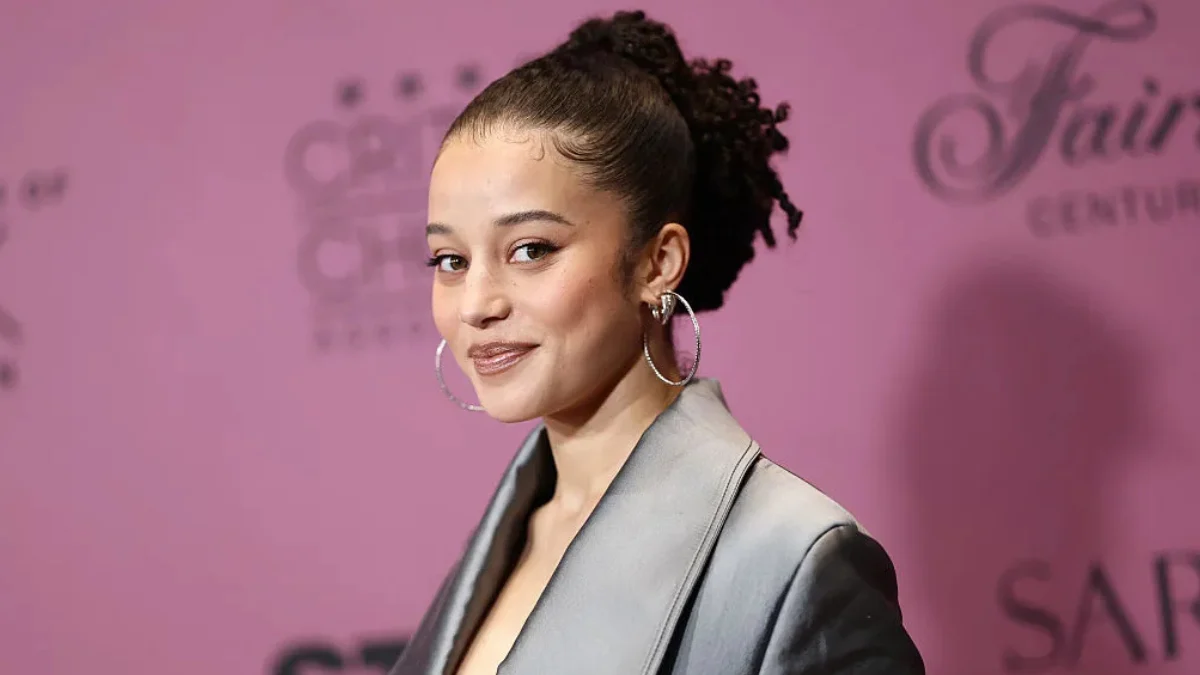
There is a version of this story where Chase Infiniti graduates from Columbia College Chicago, moves back to Indianapolis, and spends the next decade performing in regional theater productions. That version almost happened.
She enrolled in 2018 with one goal: Broadway. Film was not the plan. Hollywood was not even a thought. She was a theater kid from Indiana who wanted to stand on a stage, not in front of a camera.
Then a pandemic forced her classes online, a professor pulled her aside with a quiet observation, and a senior showcase caught the attention of a stranger who she assumed was running a scam. Within three years of graduation, she was standing on an IMAX screen opposite Leonardo DiCaprio.
What happened inside those four years at Columbia College Chicago was not just a degree. It was a complete transformation, one that Chase Infiniti herself has said she never could have predicted. This is the education story that built a star.
Why She Chose Columbia College Chicago for Musical Theater
Choosing where to study is rarely a simple decision for a serious performing arts student. New York has Juilliard and NYU Tisch. Los Angeles has USC and CalArts. And then there is Chicago, a city with a theater culture so deep and serious that it operates almost entirely on its own terms, unconcerned with Hollywood’s proximity or New York’s prestige.
Chase Infiniti studied musical theater at Columbia College Chicago with plans to pursue a career onstage. That framing is important. She was not going to Chicago to launch a film career. She was going because she wanted to act in musicals, on real stages, in front of real audiences. Columbia was the right school for that particular goal.
She credits Chicago as formative in her portrayal of Willa, sharing how the support network of friends, peers, and professors provided a strong foundation for her to take on roles that put her outside of her comfort zone. She cites Chicagoans’ overall knack for building community and protecting the found family as another touchstone of inspiration.
That is not the kind of thing you say about a city you merely passed through. Chicago got into her. The people, the pace of the theater community, and the particular way Chicagoans build loyalty around shared creative work. All of that shaped how she eventually approached character, connection, and performance under pressure.
It was the right city. It just turned out to be the right city for reasons she had not anticipated when she arrived.
Her BFA in Musical Theater and What It Covered
A Bachelor of Fine Arts in Musical Theater is not a general arts degree with some singing on the side. It is one of the most physically and emotionally demanding undergraduate programs in the performing arts. The training is comprehensive by design.
During her time at Columbia College Chicago, Chase trained in musical theater, tap dance, voice, and theater performance. Tap specifically requires a kind of bodily precision and rhythmic intelligence that carries over into every other form of physical performance. You learn to hear music differently when your feet have to respond to it in real time.

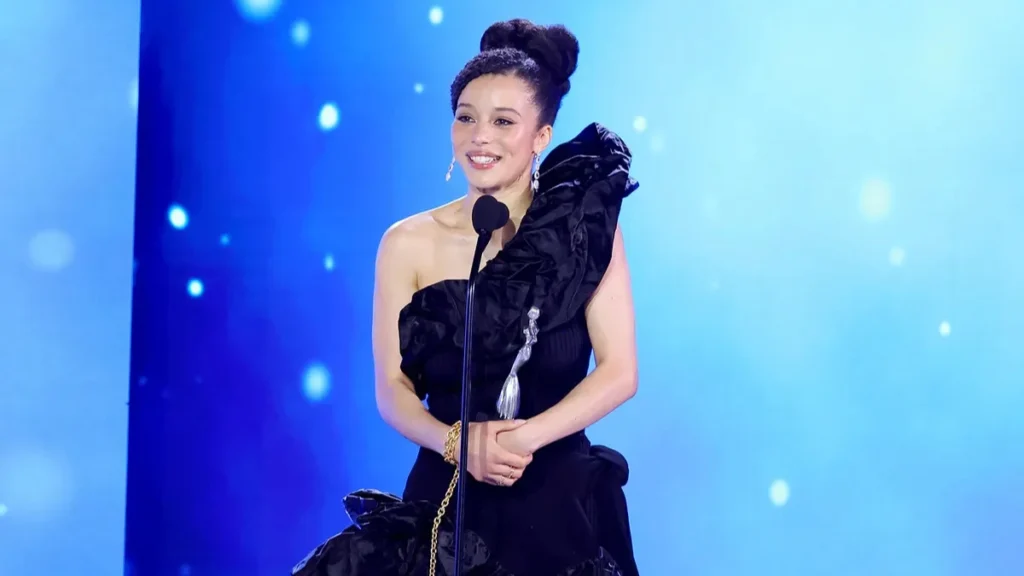
At Columbia, she also performed in full-scale productions. She played a brief role as Arista, one of Ariel’s sisters, in the school production of The Little Mermaid. In addition to her main role, she was Ariel’s understudy, allowing her to experiment with various acting styles. Being an understudy sounds like a supporting role, but it is actually an intensive acting exercise. You have to know a leading character so deeply that you could step into the role on no notice and carry the show. That kind of preparation teaches you something about focus and readiness that cannot be taught in a classroom.
She credits the Columbia faculty members who helped shape her path. “It was really two professors who stuck with me,” she says. “(Former faculty member) Justin Brill was one of the first professors who really helped empower me in my craft. He opened my world of coloring a character in ways that I had never imagined.”
That phrase, coloring a character, is a performer’s phrase. It describes the process of finding the texture, the contradiction, the humanity inside a role that could otherwise be played flat. It is the difference between performing a character and inhabiting one. Brill taught her that distinction early. It shows in everything she has done since.
Kickboxing Instruction and K-Pop Between Classes
Here is the part of Chase Infiniti’s college biography that most people cannot quite make sense of when they first hear it. A musical theater student who teaches kickboxing and films K-pop dance covers in her spare time.
It sounds like a personality quirk. It was actually a complete physical education running parallel to her formal training.
“I went to school for musical theater, and so I am familiar with moving my body in a space, but I was also a kickboxing fitness instructor,” Infiniti said. “Dance helped me be aware of the demands of all types of choreography, but it also taught me to keep myself as safe as possible while I was moving.”
That last point is not a throwaway line. On film sets, especially those involving action sequences, the ability to move safely under physical pressure is not optional. Actors get hurt. Stunt coordinators manage risk. But an actor who already understands how her body distributes force, how to absorb impact, how to move with control and not just expression, is an actor who can take on more demanding work without the production shutting down around her.
When asked about her K-pop interest, she said, “What drew me in immediately was how entertaining it was to watch. Listening to your favourite songs is fun, but learning the choreography is a whole new experience.”
K-pop choreography is notoriously precise. The genre demands synchronization, spatial awareness, and the ability to hold performance energy while executing technically demanding movement. None of that is wasted on a musical theater student. All of it transfers.
What looked like two unrelated hobbies was actually the construction of a physical instrument that would prove exactly right for the work that was coming.
Co-Founding Duple Dance Crew During Her College Years
Most college students with serious artistic ambitions keep their extracurriculars modest. Chase Infiniti co-founded a dance group.
Outside of the theater, she became an active member of Duple Dance Crew, where she performed with other Chicago dancers to film K-pop covers. The crew had a YouTube presence and a genuine following within Chicago’s K-pop dance community, which is more substantial than most people outside that world would expect.
She appeared in various dance videos on the Duple Dance Crew YouTube channel, dancing on songs including Savage by aespa and RUN2U by STAYC.
These are not casual living room videos. K-pop cover crews typically film in proper studio spaces with careful attention to formation, timing, and camera framing. It is a discipline that sits at the intersection of performance and production, one that teaches you not just how to dance but how to be filmed while dancing, how to stay in the moment while being conscious of where the camera is. That specific skill, being present and physical while maintaining awareness of the lens, is something screen actors spend years developing. She was doing it in college for fun.
It was this combination that later proved directly useful. When showrunner Bruce Miller was casting The Testaments, he watched both Presumed Innocent and Chase’s K-pop dance covers, citing her versatility as a key reason for casting her. A Hollywood showrunner watched a college dance crew video and made a casting decision. That is not a coincidence. That is preparation for meeting an audience it did not know it had.
The 2022 Senior Showcase That Landed Her an Agent
The senior showcase at a performing arts college is a high-stakes industry event dressed up as a school presentation. Agents, managers, and casting directors attend. Careers begin and end in those rooms.
Chase Infiniti’s showcase moment had an unusual wrinkle: it happened virtually, because of COVID.
At Columbia College Chicago’s Senior Showcase, Chase performed cuts from No One Else from Natasha, Pierre and the Great Comet of 1812, and I Got Love from Purlie: The Musical. Both are demanding song choices. Natasha, Pierre, and the Great Comet of 1812 is a complex, emotionally layered musical that requires vocal sophistication and a specific kind of theatrical intelligence. Purlie: The Musical is rooted in the civil rights movement and demands emotional authenticity and vocal power. Choosing those two pieces was a statement about range and seriousness.
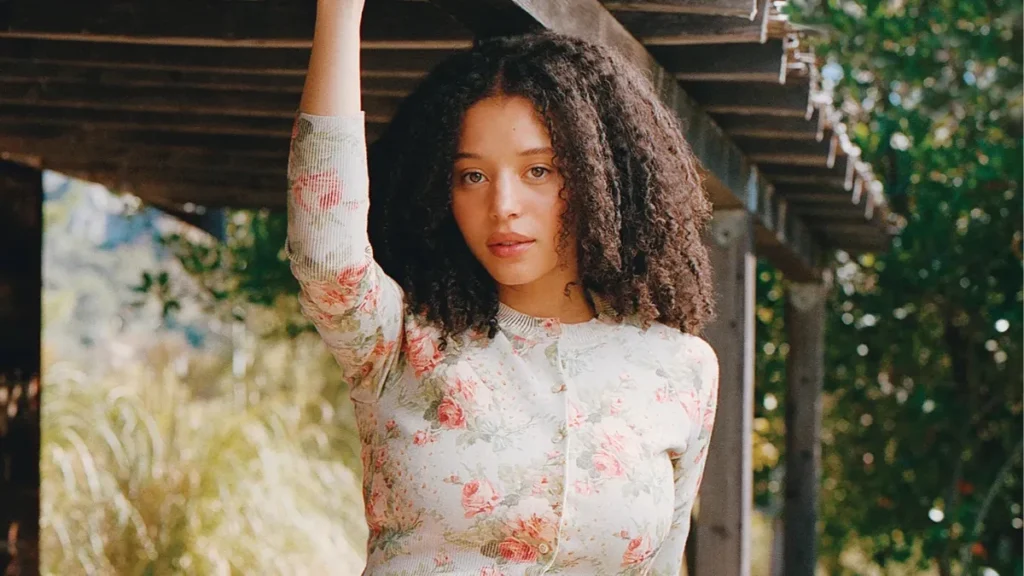
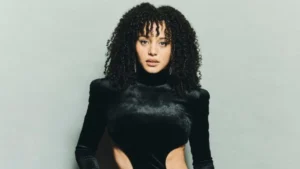
Her 2022 senior showcase caught the attention of a manager. “I thought he was a scam at first,” she says. “It was too easy, there’s no way I’d get that lucky day one.” But sure enough, that manager helped her get an agent.
That instinct, assuming it was too good to be true, is a completely understandable response for someone who had spent years grinding through regional theater in a city that is not Hollywood. Good things were not supposed to happen this fast. And yet.
Infiniti started auditioning and auditioning and auditioning, averaging five tryouts per week over the span of six months. The manager and agent opened the doors. Chase Infiniti walked through all of them, every single week, for half a year, until one finally led somewhere.
That tenacity is the part that does not show up on a resume. But it is the part that actually got her the job.
How Her Degree Shaped Her Physicality on Screen
When Paul Thomas Anderson went looking for someone to play Willa in One Battle After Another, he was specifically searching for a performer with martial arts or gymnastics experience who could also carry the emotional weight of a lead role. That is an unusual combination to find in one person. Chase Infiniti had spent four years at Columbia College Chicago, accidentally building exactly that combination.
Professor Wendi Weber, now an associate professor of instruction in the School of Theatre and Dance at Columbia, says the pandemic years gave Infiniti an unexpected gift. “She was in two of my acting classes during COVID, one fully on Zoom and one hybrid with self-tapes, masks, and distancing. For Chase, who was training in musical theater, getting to explore such an emotionally complicated world on-camera was a real gift to her creative process and presence.”
Weber was the professor who first told her to consider film. She was the first person to pull Chase aside and say, “I really think that you could act on camera,” something Infiniti had never thought of before. Chase’s response at the time, her own words, was essentially: sure, whatever, maybe one line someday. She was not dismissive out of arrogance. She was dismissive because she genuinely could not imagine it being real.
What the BFA gave her, beyond the technique and the physicality, was the ability to trust her instrument completely. A performer who has trained intensively in voice, dance, tap, physical theater, and on-camera work across four years does not get on a film set and wonder what to do with her body. She already knows. The camera just catches what the training built.
“Watching it on an IMAX screen was the moment I thought, ‘My God, I didn’t realize the scope of what I had just done,'” she says.
That moment of recognition, standing in a theater watching herself on an IMAX screen for the first time, is the final beat of a story that started in a Columbia College Chicago classroom during a pandemic, when a professor told a musical theater student something she almost did not believe. Four years of training, a K-pop dance crew, a kickboxing studio, a senior showcase, and five auditions a week for six months. That is what a BFA in Musical Theater from Columbia College Chicago looks like when it works the way it is supposed to.